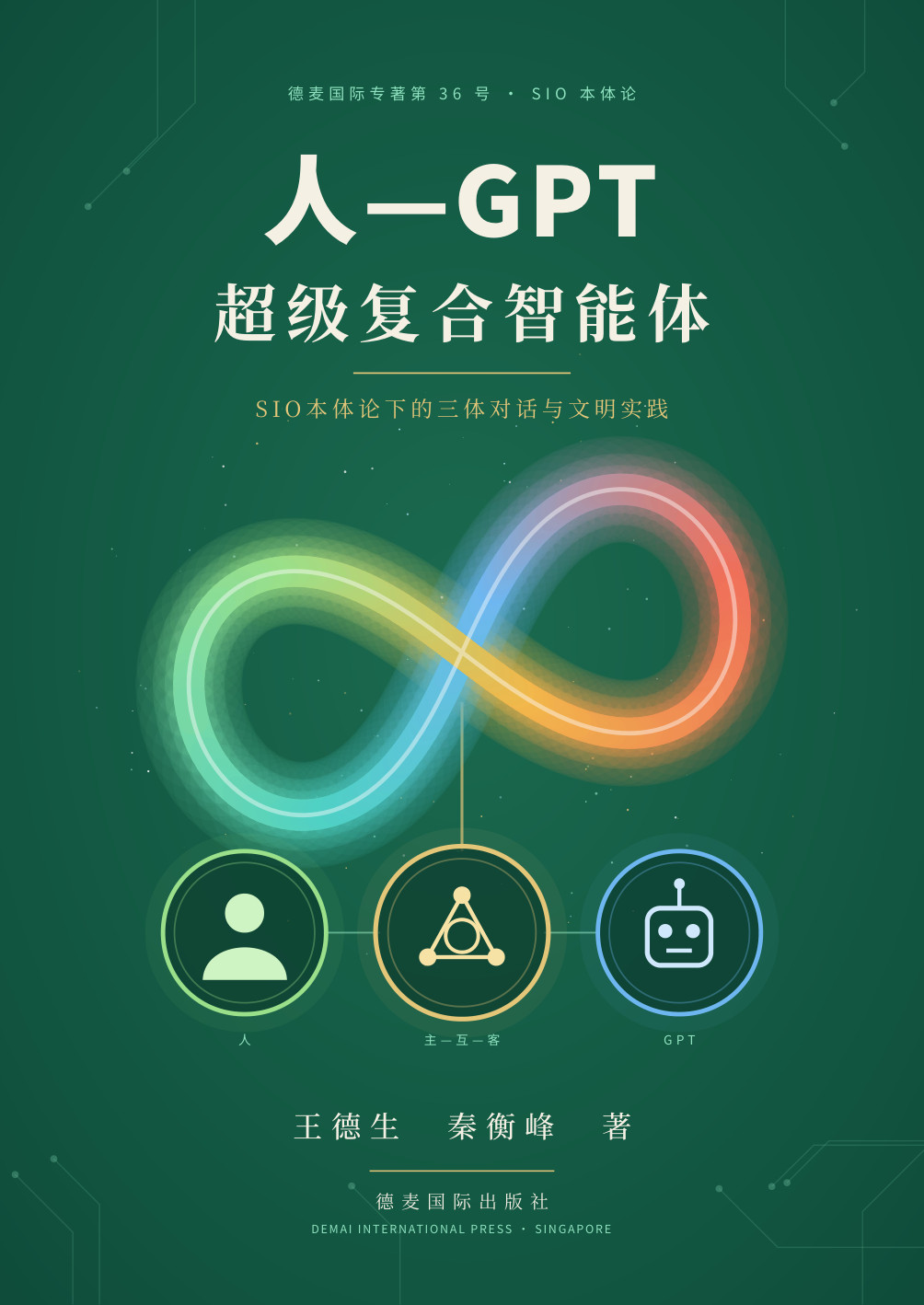
人—GPT超级复合智能体
SIO本体论下的三体对话与文明实践 · Human-GPT Super Composite Intelligence
关于生成式 AI 的讨论,大多卡在两种叙事里:一种是「人 vs GPT」,一种是「GPT 只是工具」。本书给出第三个起点。它先用 SIO 本体论(主—互—客)重写三个概念:存在不是一座实体的仓库,而是主—互—客整体在现实、理念、自我三界中的持续生成;GPT 是理念界里的意义三律引擎,长于把语言结构化、把路径展开、把张力说出来,却没有身体、生命史与自我;智能体是特征律、自由律、幸福律三律得以正常运行的整体。
在这块地基上,中编追踪人—GPT 关系从工具期、伙伴期到复合萌芽期的发生,并把提示语讲成「场域布置」而不是命令;下编落到两个原型场域:教师—学生—GPT 的三体课堂,医生—病人—GPT 的三体对话医疗。
四块骨架
全书结构
- 导论 从「人 vs GPT」到「人—GPT超级复合智能体」
- 上编 本体与智能的重构 第一篇《存在是什么?》(七编十九章)· 第二篇《GPT 是什么?》(五编十二章)· 第三篇《何谓智能体?》(九章)
- 中编 发生学三阶段 第四、五篇《人—GPT 超级复合智能体的诞生》上、下(十六章,另有结论章、后记、附录)
- 下编 文明实践 第六篇《教育的超级复合智能体》(四编十一章)· 第七篇《健康的超级复合智能体入门》(十一章,另有特别章)
- 结论 · 金句集锦 · 致谢 · 参考书目
著者
王德生,SDE(显露·差异序列·特征纠缠)本体论思想体系的创立者,德麦国际创办人。本书写于其思想体系的 SIO 本体论阶段,书中的主—互—客、意义三律与三界,是后来 SDE 本体论的前一站。
秦衡峰,博士,湘潭大学机械工程与力学学院副教授,SIO 理论的研究者与传播者。近年与王德生合作,把 SIO 本体论延伸到知识生成与人机互动的研究中,探讨使人—GPT 协作可问责、可复现、以发展为导向的互动范式与评价原则。
延伸阅读 · 三篇相关文章
Book Description
In a world where generative AI is framed either as a looming rival (“humans vs. GPT”) or as a harmless utility (“GPT is just a tool”), Human-GPT Super Composite Intelligence proposes a third starting point: intelligence is not a point-like property of a person or a model, but an emergent whole formed through sustained interaction. Grounded in SIO ontology (Subject-Interaction-Object), the book repositions GPT as a powerful engine in the idea-domain, and introduces the Human-GPT Super Composite Agent as a developmental process — tool use, partnership, composite emergence — driven by Meaning’s Three Laws: the Feature Law, the Freedom Law and the Happiness Law. Two prototypes make the framework practical: the Teacher-Student-GPT three-body classroom and the Doctor-Patient-GPT three-body healthcare dialogue.
版本说明
本书 2026 年 1 月出版(ISBN 978-1-970820-32-4)。网络版据著者初稿打磨重排:统一三编七篇的层级与称呼,清去公式粘贴重影、对话残留与错别字,对齐成稿前的旧书名与篇目预告,核对参考书目著录;著者的判断、论证与长句文风未改。封面按正式封面的意思重画为矢量。